Documentary Screening & Roundtable | Romanian Parliament, Bucharest | 15 June 2026
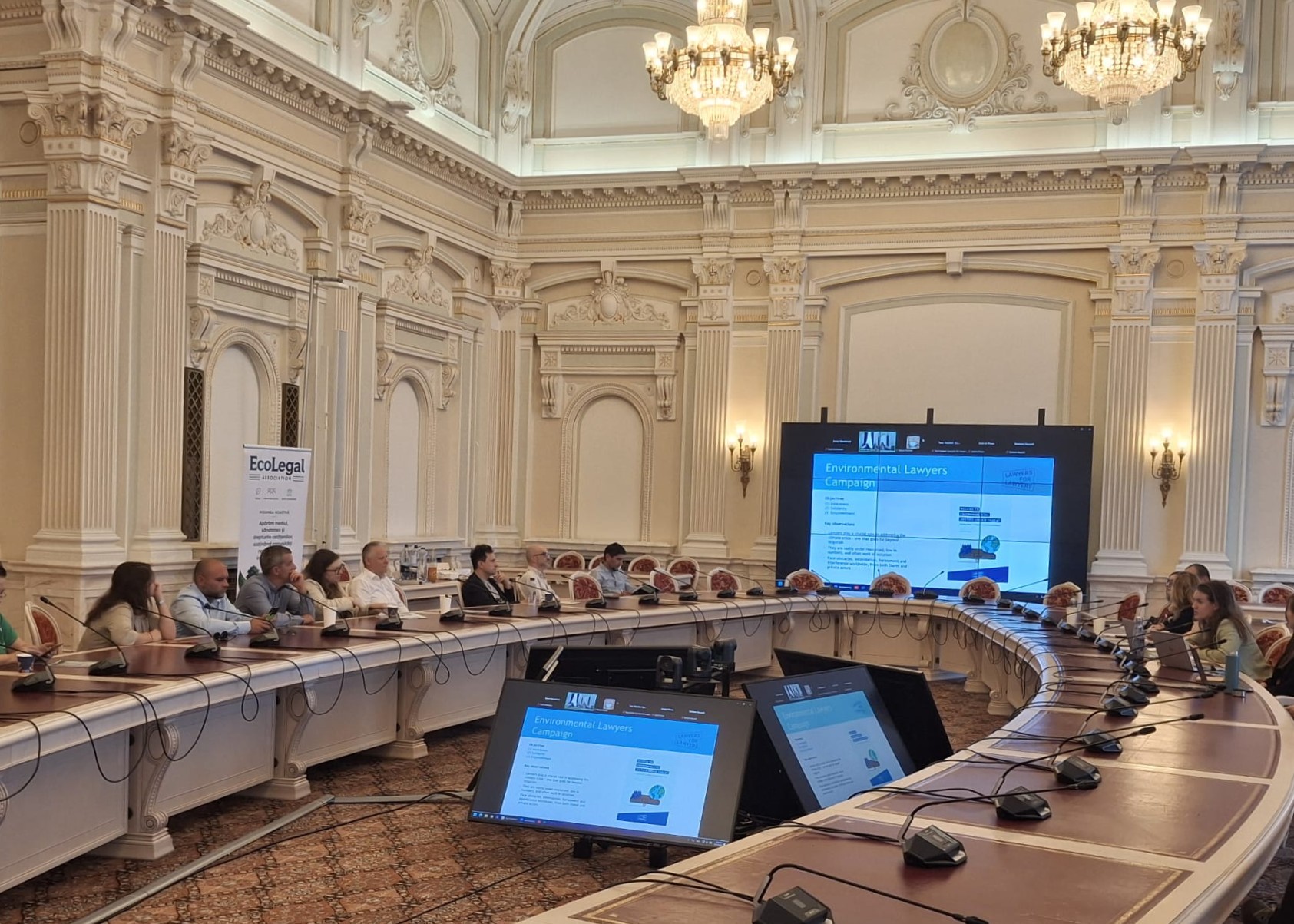
On 15 June 2026, Lawyers for Lawyers and EcoLegal Association, together with BankWatch Romania, Eco Civica Foundation, and EcoPolis, hosted an afternoon of reflection and dialogue on the role of legal professionals in advancing access to climate justice, at the Romanian Parliament in Bucharest.
The event opened with a screening of Guarding Gaia, our 26-minute documentary featuring environmental lawyers in Armenia, Colombia, Thailand, and the DRC. The film set the scene for the roundtable that followed: speakers and attendees alike drew parallels between the pressures faced by colleagues in those countries and the realities confronting environmental lawyers and defenders in Romania today. The message was clear – the chilling effects of SLAPPs, intimidation, and professional risk are not distant phenomena, but present and urgent challenges at home.
The panellists – speaking from legal practice, civil society, and the frontlines of environmental and human rights defence – reflected on the obstacles to access to justice in environmental matters in Romania, from accountability gaps for environmental harm to the limited engagement of the broader legal profession with environmental law. While attorneys Cătălina Rădulescu and Cristinel Buzatu brought the practitioner’s lens, and described how government authorities instrumentalise the legal system to prevent effective access to justice in environmental matters, Dorina Milea (AER Muntenia Sud) and Vlad Popescu (BankWatch Romania) offered compelling grassroots civil society perspectives, detailing their responses to intimidation and SLAPP-suits they faced in retaliation for defending the environment. Margarida Martins of the European Environmental Bureau (EEB) joined online, sharing valuable resources for EHRDs seeking to engage with European and international mechanisms and advance the implementation of environmental law.
The roundtable that followed produced a rich set of practitioner perspectives on priorities for environmental justice in Romania, situated within the broader European and international context — including Romania’s obligations under the Aarhus Convention and the momentum created by the upcoming report of the UN Special Rapporteur on the independence of judges and lawyers.
Attendees shared powerful testimonies of their work defending the right to a healthy environment for current and future generations, and of the many obstacles that remain in holding polluters and public actors accountable for harm caused. These included longstanding failures to address the health impacts of illegal and non-compliant landfills on nearby communities – a problem severe enough that the European Court of Justice fined Romania in 2023 for failing to close dozens of unauthorised landfills, with many sites still unremediated years after initial deadlines — as well as pollution from industrial and agri-food operations that continues to affect the health and environment of local communities. Participants also spoke to the attempts by corporate and government actors to silence those who protest such practices: environmental activism in Romania remains robust, but activists continue to face pressure and the threat of SLAPP-type lawsuits, and Romania has yet to adopt dedicated anti-SLAPP legislation.
Indeed, the broader political environment suggests that NGOs and individuals engaged in public interest work on environmental and human rights issues in Romania are set to face continuing and increasing pressure from authorities: the Romanian Senate adopted a proposal in May 2026 that would require all associations and foundations to publicly disclose the identity of their donors – a measure civil society warns mirrors so-called “foreign agent” laws adopted elsewhere, and which could accelerate restrictions on civic space. At the same time, Romania’s Superior Council of Magistracy (CSM) adopted a decision on 9 June 2026 characterising media reporting and civil society criticism as an “unprecedented attack” on the justice system — a move condemned by a broad coalition of NGOs, professional associations, and civic groups as an attempt at censorship and intimidation.
We thank Cătălina Rădulescu, a trailblazing environmental lawyer whose dedication continues to inspire, and all panellists, partners, and participants who brought their expertise and testimony to this conversation. We are also grateful to our colleagues at the Romanian Parliament for their support in facilitating this event.
This event was organised under Lawyers for Lawyers’ Environmental Lawyers Campaign.