
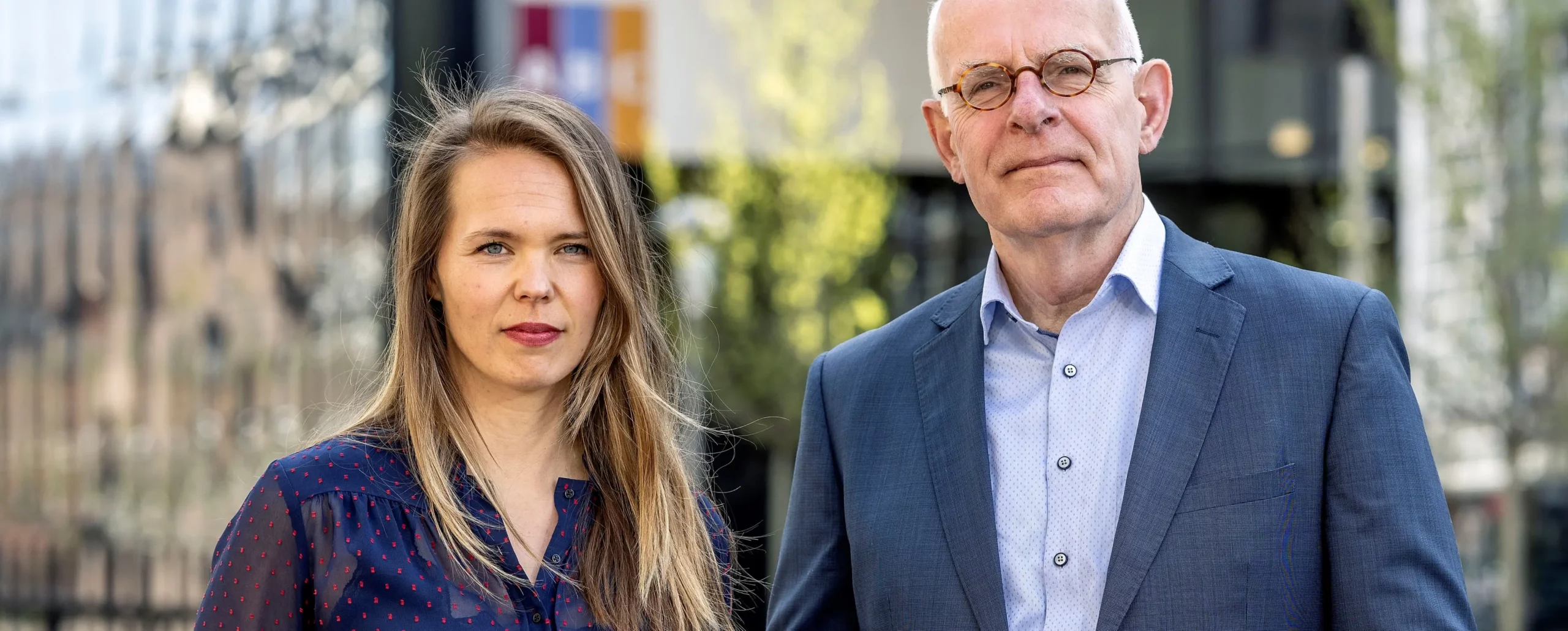
Recently, director Sophie de Graaf and board member Jeroen Brouwers were interviewed by the Advocatenblad.
We are very grateful to the Netherlands Bar Association (Nederlandse Orde van Advocaten) for the collaboration. Please find a translated version of the article below.
Forty years of Lawyers for Lawyers: protection for lawyers is needed more than ever
An anniversary is usually a time for cake, bunting and congratulations. But the 40th anniversary of Lawyers for Lawyers has a serious undertone. The organisation supports lawyers worldwide who are threatened, persecuted or arrested because of their work. That support is badly needed, especially now that increasingly more lawyers are under pressure.
According to director Sophie de Graaf, this growth is clearly reflected in the organisation’s work: ‘Five years ago, we were supporting a hundred lawyers in 25 countries; now there are around 250 in forty countries. Whereas signals used to come mainly from distant countries such as Colombia and the Philippines, we now see them coming more frequently from Europe and the United States.’
Working freely and independently
Lawyers for Lawyers was founded in 1986 following a solidarity campaign for Argentine lawyers who had ‘disappeared’ or been detained without trial under the military junta. Lawyer and cartoonist Willem van Manen founded the organisation, with the support of Amnesty International, the Nederlands Juristen Comité voor de Mensenrechten, the Netherlands Institute of Human Rights at Utrecht University and the Dutch Bar Association.
Over the past forty years, Lawyers for Lawyers has grown into an independent non-profit organisation with eight employees, 170 volunteer lawyers and thirty partner firms. Together with law firms, the Dutch and local bar associations, and international human rights organisations, they work towards a single goal: ensuring that lawyers can practise their profession freely and independently. In 2022, the organisation was awarded the prestigious Geuzenpenning for this work.
Government measures hit the rule of law
That pressure on lawyers is now coming closer to home becomes apparent from a recent example from the United States. President Trump issued executive orders against several law firms there. Amongst other things, these restricted their access to government buildings and affected clients’ government contracts. According to the government, the firms posed a threat to public interests. Critics, however, view the measures as retaliation for cases in which the firms opposed Trump’s policies. Lawyers for Lawyers submitted an amicus curiae brief on this matter to a federal judge. In the brief, the organisation expressed concerns about the pressure on the independence of the legal profession and the rule of law.
Despite the legal challenge, the consequences of the government measures are noticeable. During a meeting of Lawyers for Lawyers, an American lawyer explained that many firms have now become more cautious about taking on pro bono cases that could be labelled as undesirable by the American authorities. Board member Jeroen Brouwer finds this development worrying: ‘It is becoming more difficult for citizens to access independent legal aid. That undermines the rule of law.’
No clear distinction between lawyer and client
In cases such as these, Lawyers for Lawyers also bases its work on international fundamental principles regarding the role of lawyers, such as independence and access to justice. These have been established by the United Nations, but are by no means observed everywhere. According to Brouwer, it is significant that the Council of Europe Convention on the Protection of the Profession of Lawyer was adopted last year. This is the first binding instrument designed to better protect lawyers. ‘That shows that the fundamental principles are under pressure.’
‘Some lawyers deliberately choose not to start a family, because otherwise the risks would also affect their family’
Among other things, the convention aims to better protect the confidential relationship between lawyer and client. It also seeks to prevent a lawyer from being regarded as an extension of their client. In some countries this goes wrong, such as in Turkey. There, lawyers are regularly prosecuted for the same offences as their clients. Evidence of this can include visiting their client in detention.
De Graaf explains: ‘I was in Berlin with a Turkish lawyer to speak at a conference. Two weeks later, he called to say he’d been sentenced to eleven years in prison. That left me speechless for a moment. He has lodged an appeal. We’ll be attending his hearing to observe and report on it.’
Support in silence and in public
Lawyers for Lawyers works with various forms of support. Attending hearings as an observer and writing reports falls under the ‘Defend’ pillar. Through this, the organisation supports lawyers and, where necessary, draws international attention to their situation.
De Graaf emphasises that this support is carefully tailored. ‘Lawyers themselves indicate what they need. They do not always want public attention. In such cases, we often opt together for quiet, diplomatic channels, such as letters to governments or complaints to UN bodies.’
Through its Influence pillar, the organisation engages with governments and international institutions to improve the position of lawyers. Since 2013, Lawyers for Lawyers has held special status with the United Nations. De Graaf: ‘That was a significant milestone. It enables us to address the Human Rights Council and various committees.’
Training provides support and strength
Through the Empower pillar, Lawyers for Lawyers helps lawyers to become stronger and more resilient. According to Brouwer, some lawyers work in relative isolation from their professional peers and the bar. ‘In Cameroon, for example, only a few lawyers dare to provide legal assistance to the LGBTIQ+ community. They face not only the risk of prosecution, but also of violence. Often, the police do not intervene.’
Because they work in such isolation, there appeared to be a particular need for joint practical training. Lawyers for Lawyers therefore organised a training week in the Netherlands for ten young lawyers from countries including India and Kyrgyzstan. With actors from the Beroepsopleiding Advocaten (a professional training programme for lawyers in the Netherlands), they practised conversations with traumatised clients who had been abused in prison. De Graaf: ‘They appreciated being able to talk about their work with colleagues from other countries. One of them even said he had made friends for life.’
Award for courage and perseverance
Lawyers for Lawyers has great appreciation for the lawyers who, despite threats, persecution and violence, continue to work for their clients. According to De Graaf, these are people of great courage, who sometimes make huge sacrifices. ‘Some deliberately choose not to start a family, because otherwise the risks would also affect their family.’
To demonstrate their appreciation, Lawyers for Lawyers presents an award every other year to lawyers who are committed to human rights and access to justice. Last year, the award went to the Angolan lawyer Zola Ferreira Bambi. He received the award for his work in defending fellow lawyers, journalists and human rights defenders in Angola, often under threat, surveillance or attack.
Extra support needed to help more lawyers
Bambi’s story illustrates why the work of Lawyers for Lawyers is so important. Their support is needed more than ever as the pressure on lawyers is mounting and the independent legal profession requires greater protection. In doing so, it also draws attention to the importance of the rule of law. The organisation therefore aims to expand in the coming years. This will require additional staff and financial support.
To mark its 40th anniversary, the organisation is therefore launching a campaign to find at least 40 additional Friends: people who wish to support Lawyers for Lawyers with an annual tax-deductible donation and thus contribute to the protection of the rule of law worldwide. More information on this can be found here.