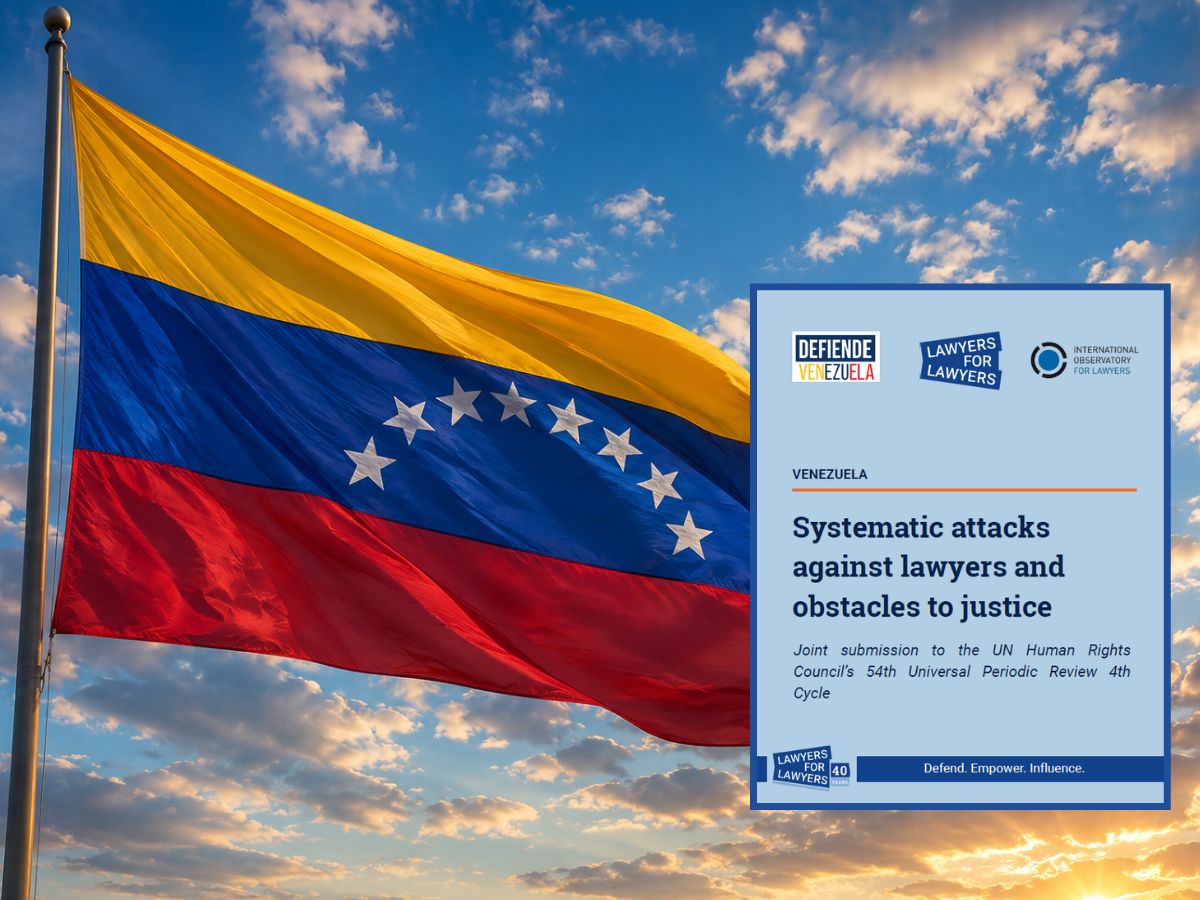
On 17 July 2026, Lawyers for Lawyers (L4L), together with the International Observatory of Lawyers at Risk (OIAD) and Defiende Venezuela (DV), submitted a joint report for the fourth cycle of the Universal Periodic Review (UPR) of the Bolivarian Republic of Venezuela. The review will take place during the 54th UPR Working Group session of the United Nations Human Rights Council.
Background and scope of the submission
The submission is based on ongoing documentation carried out by the submitting organisations, including interviews with lawyers practising in Venezuela and Venezuelan legal professionals in exile. It examines the deterioration of guarantees for the independent exercise of the legal profession and the impact of these violations on access to justice and the right to a fair trial.
The report focuses on the following thematic areas:
- Background and legal-institutional framework affecting the independence of the legal profession;
- Lack of guarantees for the practice of law, including criminalisation, harassment, surveillance and attacks against lawyers;
- Restrictions on the right to an effective defence, including barriers to appointing lawyers of one’s choice and accessing clients and case materials;
- The impact of these violations on the legal profession and access to justice.
Failure to implement previous UPR recommendations
The submission highlights Venezuela’s failure to meaningfully implement recommendations accepted during the previous UPR cycle concerning the protection of human rights defenders, access to justice, judicial independence and due process guarantees.
During the third cycle of the UPR, Venezuela received recommendations calling for an end to the persecution, criminalisation and imprisonment of human rights defenders, as well as measures to guarantee access to justice and the independence and impartiality of the judiciary. While several of these recommendations were accepted by the Venezuelan State, information gathered for this submission indicates that they remain largely unimplemented.
Instead, lawyers, particularly those representing political detainees, human rights defenders and victims of human rights violations, continue to face intimidation, criminal prosecution and restrictions preventing them from carrying out their professional duties independently.
Criminalisation, arbitrary detention and attacks against lawyers
The report documents a persistent pattern of criminalisation of lawyers in retaliation for their professional activities, including representing individuals perceived as government opponents or defending human rights cases.
Lawyers have been subjected to arbitrary arrests, enforced disappearance, incommunicado detention and criminal proceedings based on vague accusations, including terrorism, conspiracy, criminal association and treason. These proceedings are frequently accompanied by serious violations of due process guarantees, including the denial of the right to appoint a lawyer of one’s choice and judicial decisions lacking adequate reasoning.
The submission highlights cases including those of lawyer and human rights defender Eduardo Torres, trade union lawyer Emilio Negrín, Foro Penal lawyer Kennedy Tejeda, and lawyer and human rights defender Rocío San Miguel, all of whom faced prosecution and detention in connection with their legitimate professional activities.
Restrictions on the right to an effective defence
The submission raises serious concerns regarding persistent obstacles preventing individuals from accessing independent legal representation. Authorities have imposed administrative barriers that prevent detainees from appointing lawyers of their choosing, particularly in politically sensitive cases.
Lawyers reported being denied timely access to their clients and case files, often only being allowed to review documents shortly before hearings. They also described restrictions on visiting detention centres, intimidation during consultations with clients, and interference with lawyer-client confidentiality through surveillance, searches and recording of communications.
These practices severely undermine lawyers’ ability to prepare an effective defence and violate Venezuela’s obligations under international human rights standards.
Surveillance, harassment and forced exile
The report further documents a pattern of surveillance, harassment and intimidation against lawyers representing politically sensitive cases, human rights defenders and civil society organisations.
Lawyers reported physical and digital surveillance, interception of communications, unauthorised access to electronic information, threats of arrest, and public stigmatisation by state officials who associate lawyers with the causes or clients they represent.
As a result of these risks, several lawyers have been forced to leave the country. Those in exile continue to face obstacles in resuming their professional practice, including difficulties obtaining and legalising documentation required to validate their qualifications and persistent insecurity regarding their legal status in host countries.
Weakening of professional independence and access to justice
The submission also highlights the progressive weakening of bar associations and professional self-regulation mechanisms in Venezuela. Lawyers reported a lack of regular internal elections, alleged interference by state institutions, and increasing limitations on the ability of professional associations to publicly address attacks against lawyers.
These developments have contributed to a broader climate of fear and self-censorship within the legal profession. Many lawyers have refrained from taking on sensitive cases, reporting abuses or challenging irregularities due to the risk of reprisals.
The resulting reduction in independent legal representation directly affects victims of human rights violations and undermines access to justice and fair trial guarantees.
Recommendations
In light of these findings, our organisations urge the United Nations Member States to formulate the following recommendations to the Bolivarian Republic of Venezuela during its fourth cycle of the Universal Periodic Review:
- Refrain from taking any action that may constitute harassment, persecution or undue interference in the exercise of the legal profession, including the arrest or criminal prosecution of lawyers for illegitimate reasons, such as the expression of critical opinions or the nature of the case in which they are professionally involved.
- Take immediate steps to ensure that lawyers have full access to their clients and restore and ensure the absolute confidentiality of communications between lawyers and clients.
- Take immediate steps to ensure due process and the right to a fair trial, including respect for the right of every person to freely choose and be assisted by a lawyer of their choosing, as well as full and timely access for lawyers to court records, without undue delays or restrictions, so that they can provide effective legal assistance to their clients, and refrain from any action that limits their ability to prepare an adequate defence.
- Take effective measures to ensure that threats, acts of harassment and other violations committed against lawyers are effectively investigated and that those responsible are brought to justice.
- Immediately repeal laws that hinder the protection of human rights and the rule of law by persecuting or stigmatising individuals and organisations, including lawyers, legal aid organisations and civil society organisations, or reform them to ensure their full compliance with international human rights standards.
- Guarantee the effective, uniform and non-discriminatory application of the 2026 Amnesty Law by adopting the necessary legislative, administrative and judicial measures, ensuring the comprehensive reparation of the beneficiaries and that their access respects the principles of equality of the parties, equality of arms and due process, avoiding selective or discriminatory practices in its granting.