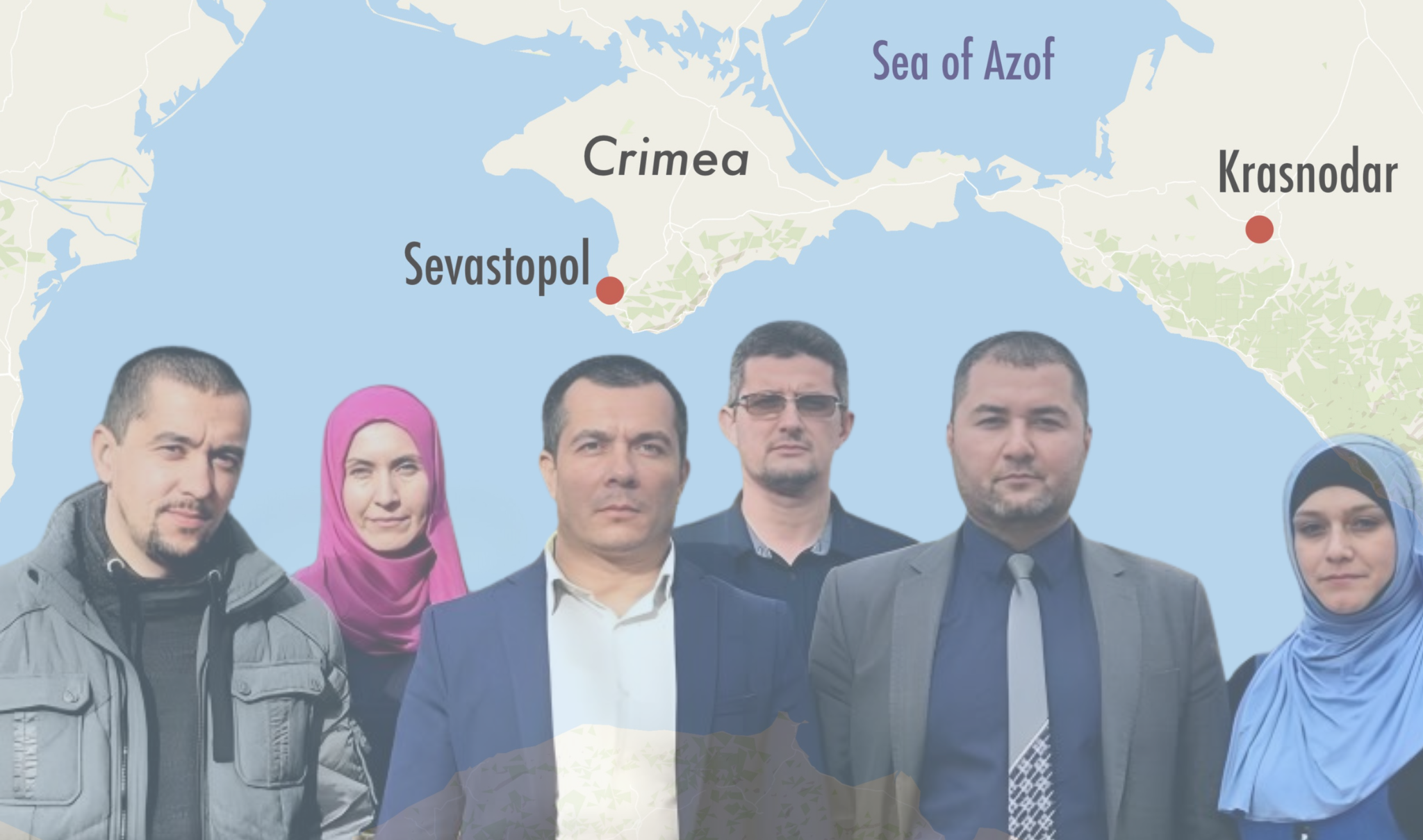
Lawyers for Lawyers, together with the Law Society of England and Wales, the International Bar Association’s Human Rights Institute, Federation of European Bars and International Observatory for Lawyers at Risk, is gravely concerned by the Russian authorities’ escalating attacks on lawyers in occupied Crimea, including the recent designation of 16 lawyers as ‘foreign agents.’
On 26 June 2026, Russia’s Ministry of Justice designated the Crimean Solidarity human rights movement a ‘foreign agent’ in what observers regard as the latest attempt to silence its legitimate human rights activities. The movement was established in 2016 by lawyers, journalists, and relatives of those arrested following Russia’s occupation of Crimea to provide legal advice to detainees and financial and other practical assistance to their families. The designation was simultaneously applied to eleven others including lawyers, civic defenders and journalists who have defended, supported, or reported on victims of persecution in occupied Crimea. Following this designation, Crimean Solidarity was left with no alternative but to terminate its activities as a movement, announcing this decision in a statement on 21 July 2026. Then, on 24 July 2026, the ‘foreign agent’ designation list was updated to include more than 137 individuals including lawyers, human rights defenders, activists, and current political prisoners and their close relatives. The list now names 12 Crimean Tatar lawyers living in Crimea, and 4 Russian lawyers.
In particular, the designation list names renowned defence lawyers Emil Kurbedinov, Edem Semedlyaev, Lilia Hemedzhy, Nazim Sheikhmambetov, and Rustem Kyamilev all of whom have previously faced reprisals simply for doing their jobs. Both Emil Kurbedinov and Edem Semedlyaev have been subjected to harassment and administrative prosecutions, while Lilia Hemedzhy, Nazim Sheikhmambetov, and Rustem Kyamilev were stripped of their licence to practise as defence lawyers in apparent retaliation for representing political prisoners. Alexei Ladin has also faced arbitrary disbarment and administrative prosecutions in reprisal for his exercise of his right to freedom of expression. Furthermore, the list names two civic defenders1: Server Cholakchyk and Mustafa Seidaliev.
Foreign agent designation chills the exercise of human rights and legal advocacy
Being listed as a ‘foreign agent’ in Russia has implications beyond the label. Individuals and organisations who are designated as a foreign agent must display a disclaimer on all their publications to say they were produced by a foreign agent, leading to social ostracisation, with the lawyer’s professional reputation being discredited in the eyes of the public and the court system. They face extensive reporting and auditing requirements, any errors in this process can lead to fines. Furthermore, they may be barred from certain professional and public activities, including teaching in public institutions, organising public events, and standing for elected office.
The constituting criteria of the label are vague and overly broad, creating a powerful chilling effect on freedom of expression, association, and civic participation. In the case of lawyers, such measures risk deterring legal professionals from taking on politically sensitive cases, speaking out on matters of public interest and undermine access to independent legal representation and consequently access to justice for everyone.
The Ministry of Justice claimed that the Crimean Solidarity movement had circulated false information about the Russian authorities, disseminated materials produced by foreign agents, and cooperated with members of “international terrorist organisations” and Ukrainian state bodies. The authorities have not publicly identified the specific conduct that triggered these allegations to be made.
This designation follows a longstanding pattern of harassment and reprisals against lawyers in Russia, including Crimean lawyers representing Crimean Tatars. Since 2014, reports indicate that at least 13 lawyers in occupied Crimea have been subjected to harassment by the Russian de facto authorities, including arbitrary searches, detentions, administrative arrests, fines, and politically motivated disbarments. Several of our organisations have previously highlighted the harassment of lawyers Emil Kurbedinov, Edem Semedlyaev and Lilia Hemedzhy, among others, and the broader continued systematic persecution of lawyers in occupied Crimea in January 2026 and November 2024.
Retaliation for lawyers’ legitimate professional activities
Against this background, our organisations are deeply concerned that the ‘foreign agent’ designation has been imposed not because of any genuine threat to national security, but in retaliation for the peaceful and legitimate work of the Crimean Solidarity human rights movement and the lawyers associated with it. The allegations of disseminating foreign agent materials and cooperating with terrorist organisations are vague, over-broad, and unsupported by publicly available evidence. Such allegations have repeatedly been used against lawyers, civil society organisations, media outlets, and human rights defenders across Russia.
Notably, also on 26 June 2026, the United Nations Committee on the Elimination of Racial Discrimination found that Russia has violated several articles of the International Convention on the Elimination of All Forms of Racial Discrimination (ICERD) through its persecution of three Crimean Tatar lawyers, who have faced an array of reprisals for their professional work, including arbitrary arrest and detention. The Committee combined separate applications brought by the three lawyers who claimed that their prosecution was “part of an ongoing pattern of state harassment intended to repress and silence Crimean Tatar lawyers who defend other Crimean Tatars.” The ruling found violations of the right to equality before the courts (Article 5(a)), the right of everyone to security of person and protection by the State (Article 5(b)), the right to freedom of opinion and expression as members for a protected ethnic group (Article 5(d)(viii)), the right to peaceful assembly (Article 5(d)(ix)), and the right to effective protection and remedies (Article 6). As a state party to ICERD, the Committee’s findings order Russia to make reparation for the violations of its obligations under the Convention, take further measures to ensure that existing legislation is applied in an effective manner, and give wide publicity to the Committee’s views.
Repression of the legal profession violates international human rights standards
In addition to ICERD, Russia’s sustained repression of the legal profession violates further international human rights standards and specific international standards protecting lawyers. Principle 16 of the UN Basic Principles on the Role of Lawyers (‘Basic Principles’) states that Governments should ensure that lawyers are able to perform all of their professional functions without intimidation, hindrance, harassment or improper interference; and that lawyers shall not suffer, or be threatened with, prosecution or administrative, economic or other sanctions for any action taken in accordance with recognised professional duties, standards and ethics. Principle 18 outlines that lawyers shall not be identified with their clients or their clients’ causes. These rights have been further recognised by the Council of Europe Convention for the Protection of the Profession of Lawyer, adopted in March 2025.
As a state party to the International Covenant on Civil and Political Rights (ICCPR), Russia is also obligated to protect the rights to freedom of expression (Article 19) and association (Article 22) of everyone in the state. Further, in accordance with international standards, lawyers enjoy specific protection of their freedom of expression and association. In particular, they have the right to take part in public discussion of matters concerning the law, the administration of justice and the promotion and protection of human rights and to join or form local, national or international organizations and attend their meetings, without suffering professional restrictions by reason of their lawful action or their membership in a lawful organization (Principle 23 of the Basic Principles).
Therefore, our organisations urge the Russian authorities to:
- Immediately revoke the ‘foreign agent’ designation imposed on the Crimean Solidarity movement and lawyers Emil Kurbedinov, Edem Semedlyaev, Lilia Hemedzhy, Nazim Sheikhmambetov, and Rustem Kyamilev.
- Comply with ICERD and fully implement the findings and recommendations of the UN Committee on the Elimination of Racial Discrimination, including providing effective reparations and preventing further violations.
- Halt all arbitrary criminalisation of lawyers’ legitimate freedom of expression and association in line with the ICCPR and the ‘Basic Principles’.
- Revoke the arbitrary disbarment of Lilia Hemedzhy, Nazim Sheikhmambetov, Rustem Kyamilev and all other lawyers arbitrarily disbarred in retaliation to their peaceful legal work in line with the ‘Basic Principles’.
- Guarantee that all lawyers in Russia and occupied Crimea can perform their legitimate professional duties without fear of reprisals, harassment, or undue interference and ensure that lawyers are not identified with their clients or their clients’ causes in line with the ‘Basic Principles’.
Our organisations will continue to monitor these cases.
Download the PDF version of the statement.
Signatories:
Law Society of England and Wales
International Bar Association’s Human Rights Institute
Lawyers for Lawyers
Federation of European Bars
International Observatory for Lawyers at Risk