Article by Arelí Núñez Pfoccoalata, L4L’s network member
As part of the Breaking Barriers: Women Lawyers Campaign, Lawyers for Lawyers is conducting a global interview series highlighting the experiences of women lawyers working across diverse contexts. In this second edition, released following the International Day of the World’s Indigenous Peoples, we speak with Yuteita Valeria Hoyos Ramos. Her story sheds light on the experiences of Indigenous women within the legal profession and on the role that they play challenging gender and racial discrimination, and strengthening access to justice within their communities.
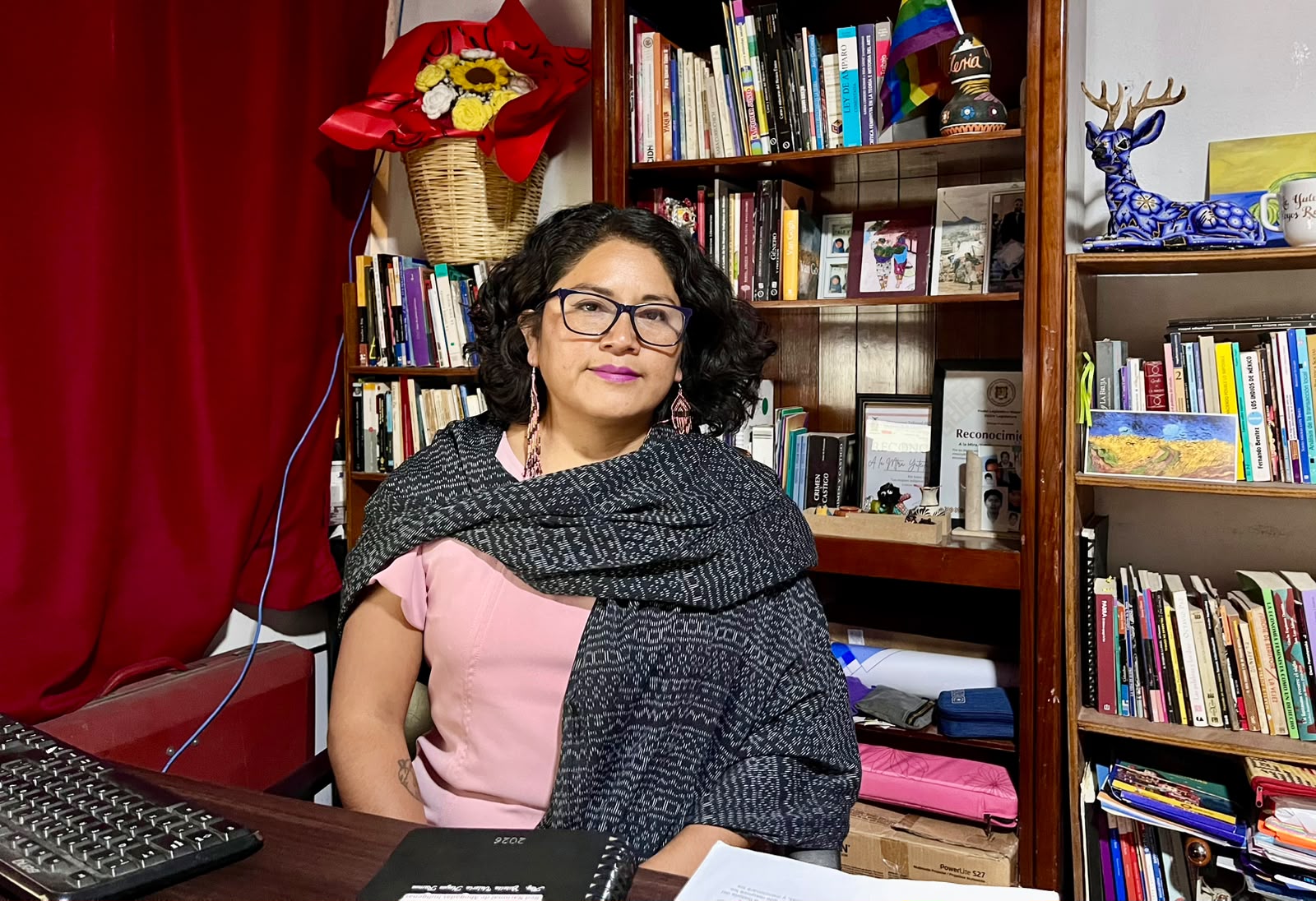
Yuteita Valeria Hoyos Ramos is a lawyer and coordinator of the National Network of Indigenous Women Lawyers (Red de Abogadas Indígenas – RAI). She is a Mixtec woman from the municipality of Santa Catarina Tlaltempán, in Puebla, Mexico. Her name, derived from Mixtec, means “river flower”. She was born and raised in a small community of around 1,400 inhabitants, deeply proud of its Indigenous identity, language, culture, dances, and forms of community organisation.
From an early age, Hoyos Ramos learned that defending who she was constituted a form of resistance. Her parents raised her and her siblings with a clear message: they should be proud of their identity and never bow their heads in the face of racism. At the same time, her own family had experienced discrimination first-hand. Her grandparents were forced by society to stop speaking Mixtec when they left the community, to the point that the language has been partially lost across generations.
Gender-based violence was also among the experiences that shaped her childhood. Yuteita remembers seeing women in her community subjected to physical and psychological violence. Her mother, aware of the limitations faced by women of her generation, insisted on the importance of her daughters studying and becoming economically independent. These family and community experiences helped shape her relationship with the law. What began as a childhood conviction about justice later became a career dedicated to using legal tools to confront discrimination and oppression.
From a desire for justice to law as a tool for transformation
At the age of 13, Yuteita discovered the law and realised that it could be a tool to defend the rights of her community. At school, when her teachers explained rights and said that people needed to turn to a lawyer to defend them, she asked herself a very concrete question: “And when are we going to have the money to hire a lawyer?” Her conclusion was simple: “We have to be the lawyers, because otherwise we won’t be able to access anything.”
From then on, social justice became one of the main motivations guiding her path. Even at university, where some professors mocked students who said they had chosen law because they believed in justice, she held on to that conviction. Today, she defines her work in three words: resistance, transformation, and hope.
For her, using the law from the perspective of Indigenous Peoples means questioning the power structures that have historically determined how laws are created and applied. This transgression takes on a particular dimension when Indigenous women occupy legal spaces and positions of power. She points out that her grandmothers were excluded from formal education and decision-making spaces, while their granddaughters are now litigating before courts and occupying public spaces. For her, this change is not an individual achievement. “Nothing here is achieved alone,” she says. The spaces Indigenous women have managed to occupy are the result of collective organisation and the support networks they have built among themselves.
Being an Indigenous woman lawyer: A bridge between two justice systems
Most of the cases Yuteita supports involve violence against women, particularly Indigenous women. Many concern domestic violence, although she also works on some criminal cases. Her work takes place at the intersection of community legal systems and the State justice system.
Within communities, she may work with authorities such as municipal presidencies, municipal trustees or justices of the peace to address cases involving violence, child support, victim protection, and other conflicts. In certain circumstances, she seeks to have cases resolved within the community itself, provided that the necessary conditions exist to guarantee the rights of those affected.
But this work is not without difficulties. Community authorities may be afraid to turn to State institutions, while attitudes of indifference or sexism may also exist within community structures themselves. In such cases, women lawyers must find ways to intervene without breaking community ties, because opening decision-making spaces to Indigenous women does not mean abandoning community organisation, but rather making it more inclusive.
When cases reach the State justice system, the situation is not straightforward either. Yuteita describes her work as a bridge between justice systems, navigating between community justice and State justice and seeking to foster dialogue between the two.
The risks of challenging power structures
Defending Indigenous rights and challenging institutions also have personal and collective consequences. Yuteita explains that members of RAI have been publicly dismissed by judicial authorities and political actors, including through remarks that diminish their work because they are Indigenous women.
On one occasion, the names, professional licence numbers, and office address of members of the organisation were published by a local media outlet after they represented an Indigenous community. The exposure triggered a wave of hateful comments on social media, and the lawyers subsequently realised that the publication could also pose a security risk to them and their families.
They have also experienced attempts to discredit their work in the eyes of the people they represent. Yuteita recounts that some authorities have sought to create mistrust between the lawyers and their clients by questioning their work or suggesting that they are not doing enough. Yet the relationship of trust they build with communities is precisely one of their greatest strengths.
A form of justice that also challenges sexism within communities
For Yuteita, defending the rights of Indigenous women does not mean idealising community structures. Her work requires recognising both the value of community organisation and the inequalities that may exist within it.
“We challenge conventions and established norms” she explains, because they also challenge patriarchal dynamics within community systems of decision-making structures.
In the dialogue spaces they support, for example, she insists that participation should not be limited to men, but should also include women. This also helps make visible the work of women that has traditionally remained in the background within communities.
Yuteita further points out that women often play a fundamental role in carrying out the community responsibilities formally held by their husbands, even though their contribution is not officially recognised.
RAI: Building power and knowledge collectively
Yuteita coordinates the National Network of Indigenous Women Lawyers (RAI), Mexico’s first network of Indigenous women lawyers. The organisation was created in 2011 and formally established in 2017 with the aim of developing a critical perspective on Mexican law from both an ethnic and gender perspective.
RAI emerged, among other reasons, from the recognition that many Mexican laws concerning women’s rights did not adequately incorporate an intercultural perspective. For the organisation, speaking about women without considering the specific experiences of Indigenous women means excluding an important part of those whom these laws are intended to protect.
Today, RAI has 35 members and is present in ten Mexican states, bringing together women lawyers from different Indigenous Peoples. Its work addresses gender-based and intersecting forms of violence, political participation and governance, and the protection of land and territory through the principle of self-determination. The network also places particular emphasis on strengthening the knowledge and capacities of its members through training, its legal knowledge clinic, spaces for discussion, and self-care initiatives.
Collective work is fundamental to this approach. A lawyer can bring a case to the rest of the network and find legal support, specialists, interpreters, or colleagues willing to join a collective litigation effort. The network also provides a space for sharing knowledge and developing advocacy strategies. By combining litigation, advocacy, dialogue with authorities and capacity-building, RAI seeks not only to advocate for legal change, but also to ensure that Indigenous women have a voice in shaping those changes. For Yuteita, the network provides a support structure that ensures none of its members has to face the challenges of their work alone.
What sustains us is the collective
Despite the difficulties, Yuteita insists that collective work is the primary source of strength for Indigenous women working for justice.
When she thinks about girls and young women from Indigenous communities who dream of becoming lawyers, her message is not solely about individual determination. She speaks to them about the importance of coming together, organising, and supporting one another.
“Don’t let anyone tell you what you cannot do,” she says. The possibilities may seem limited, but they exist, and it is important to seize them without abandoning one’s dreams.
For her, this trust in the collective is not an abstract idea, supporting young people and girls is part of the same process of collective building that has shaped her path. Her own experience within RAI confirms this conviction. “I have grown enormously as a person and as a professional,” she explains, “but it is thanks to my colleagues.”
And perhaps this is precisely the thread running through her story: law as a tool of resistance, identity as a source of strength, and collective organisation as a condition for transforming the structures that have historically excluded Indigenous women.
It is also from this place that she looks towards the future. After years of work, difficulties, and shared learning, she retains the same determination that led her to study law and organise alongside other women:
“We still have this little flame burning brightly in our hearts, and it won’t be easily extinguished.”