By Trudeke Sillevis Smitt for The Advocatenblad
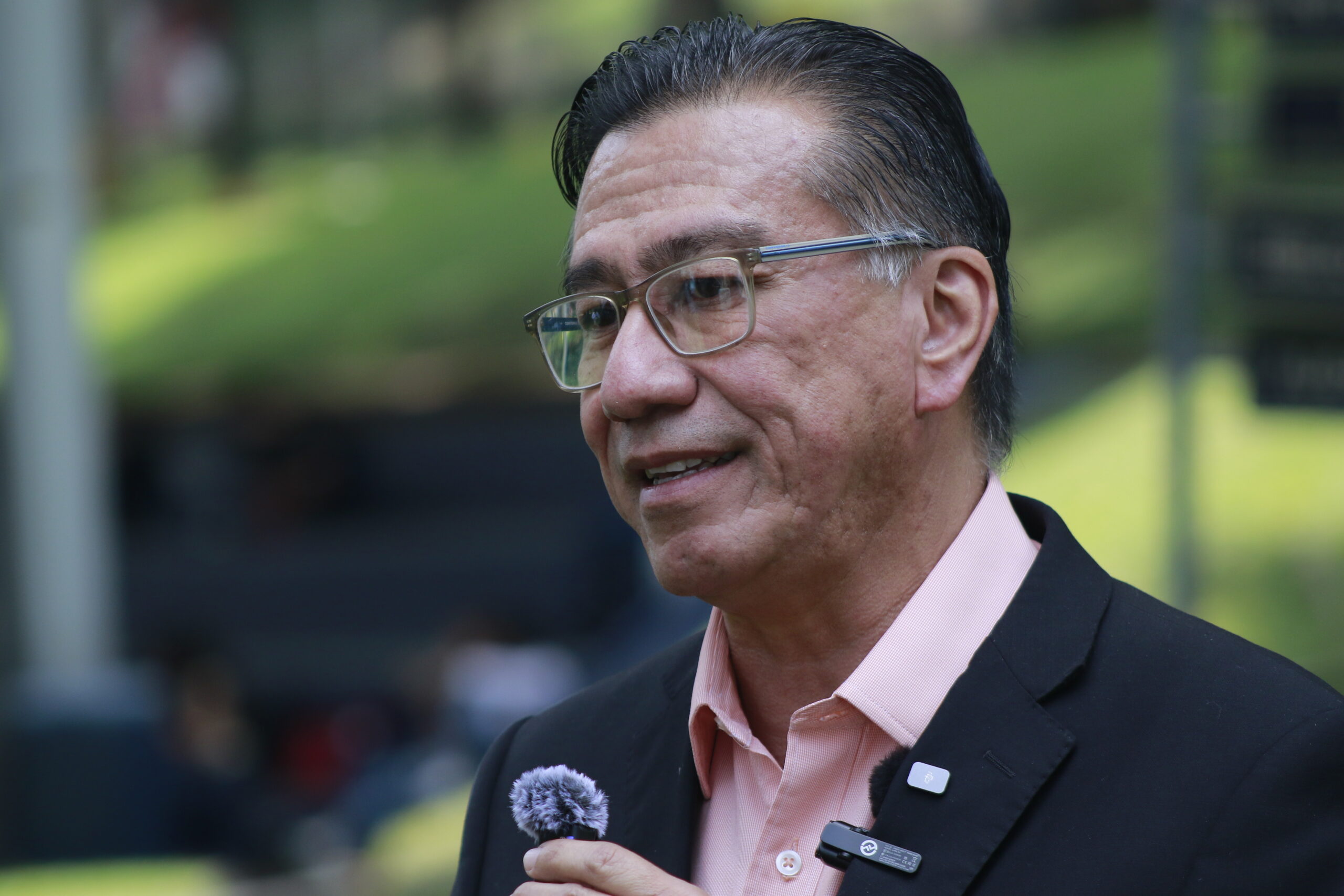
David Morales, a seasoned criminal defence lawyer and human rights lawyer from El Salvador, reflects on the situation in his home country. He joins the interview by video call from abroad, as it is too dangerous to speak from home.
Hundreds of men with shaved heads, dressed in white and wearing handcuffs, sit on plastic chairs facing a screen. Images of the mass trial held in El Salvador’s maximum-security CECOT prison spread around the world in April; evidently, the authorities are proud of them. The nearly 500 men standing trial, who are being held in different prisons, are alleged members of the criminal gang MS-13, responsible for 47,000 crimes. Since President Bukele declared a state of emergency in 2022 in response to spiralling gang violence, 91.000 people have been arrested. And look at how crime rates have fallen thanks to his policies!
But as the gang violence was reined in, the rule of law went down the drain right along with it. An investigation by the Spanish newspaper El País found that at least 33.000 detainees had never even been registered as gang members. And under these circumstances, it is impossible for the 91.000 detainees to receive a fair trial.
State terror
David Morales, a veteran Salvadoran criminal defence and human rights lawyer, watches these developments with dismay. He is a senior lawyer at Cristosal, a human rights organisation that was forced to withdraw from El Salvador a year ago following the arrest of Ruth López, who headed Cristosal’s anti-corruption unit. Morales now works from abroad. “For the past five years, the state has been exercising terror. The Supreme Court has been captured, and the Public Prosecutor’s Office has been taken over. The state of emergency has now lasted four years and has effectively become permanent. Torture is government policy, and hundreds have died in prison.”
According to Morales, the CECOT propaganda image is therefore not representative: “Most of the people shown there had already been convicted of gang-related offences. People detained in other prisons generally have no tattoos, and their appearance and testimony reveal the torture they have endured, as well as the lack of food and hygiene. Meanwhile, reforms are being introduced that completely dismantle the rule of law.” At the end of May, the government announced another reform that would allow life imprisonment to be imposed on anyone aged twelve or older, including for broadly defined offences such as “terrorism.”
Since the beginning of the Bukele regime in 2019, people have been imprisoned on a massive scale. Morales: “Police officers had to meet targets, and started arresting people based on things like an anonymous phone call or a tattoo allegedly indicating gang membership. Some suspects have now spent four years in detention without ever having their case heard, and are now appearing before a judge in mass trials. Remotely, from prison.”
“Faceless judges”
How should you work as a lawyer in these circumstances? Morales: ‘The defence is extremely limited. There is no free choice of lawyers, lawyers appointed by the government defend hundreds of people simultaneously. They do not get to speak to their clients and not a single request from the defence is granted. Hearings are not public, the trials have been declared secret. If you speak out, you risk prosecution.’
So the people on trial never see a lawyer – and never see a judge either. “The lawyers don’t see the judges either,” Morales says. “They work with ‘faceless judges,’ the argument being that they need to be protected from the gangs.”
Another invisible factor: the prosecutor’s witness. Morales: “Suspects become informants and accuse people of being perpetrators without the person in question knowing who testified against them. This has already led to convictions with absolutely no basis.”
Add to that the fact that the charges aren’t read out during the hearing, and that a single police statement is enough to secure a conviction, and you can safely conclude that the whole circus no longer has anything to do with a real criminal trial.
Can’t the legal profession do something about this as a group? “The independence of the legal profession has always been weak. We’re supervised by the supreme court, and there’s no mandatory bar association. There are associations, but they have little influence,” Morales says.
Ruth López
The organization Morales works for, Cristosal, has spoken out fiercely from the very start. Among other things, this led to the arrest of Ruth López, who headed Cristosal’s anti-corruption department.
In March 2025, when El Salvador detained Venezuelans and Salvadorans who had been picked up and deported by the United States, holding them in the notorious CECOT prison without a fair trial or legal assistance, López dared to challenge these measures. She filed 76 habeas corpus petitions on behalf of families searching for their relatives. When she was arrested, she said to the officers: “Show some decency, one day this will come to an end. Don’t let yourselves be used for this.” And as she was being led away, she shouted: “I demand a public trial!” No official charge has even been announced yet. Amnesty International has since designated López as a political prisoner.
Morales: “She was held incommunicado for months. At our request, the Inter-American Commission on Human Rights [an independent body of the Organizsation of American States, ed.] issued so-called precautionary measures. Because of that, she’s now allowed occasional family visits. But despite an order from the commission to examine the lawfulness of her detention, she remains detained, with no hearing to assess the evidence—which itself suggests that evidence simply doesn’t exist. She’s conducting her own defensce but isn’t even allowed to see the case file. And no medical information about her health has been provided.”
Despite all these developments, Bukele is immensely popular according to various media, because he succeeded in curbing the gang violence. He was re-elected in 2024 with 85 percent of the vote. What’s it like to oppose a regime that has broad public support? Morales: “Critical voices were already being suppressed in the past too. But this government makes large-scale use of social media to spread hatred and discredit our work. We’re harassed, of course. We don’t have the same resources as the government, but we do our best to strengthen our communications and expose the truth about the violations. Not just regarding criminal cases, but also to stand up for the rights of indigenous people and women. We’re not just fighting a legal battle, but a battle against propaganda too.”
Carrying on
Things may have to get worse before they get better. According to Morales, discontent in the country is starting to grow: over the social situation, poverty, unjust dismissals, and attacks on human rights defenders. “It could still be years before we’re rid of this dictatorship. If the discontent becomes organized, repression could increase. That worries me enormously, but at the same time, it’s what motivates me to keep going.”
The original publication is available in Dutch here.